Showing posts with label science and nature. Show all posts

23 July 2013

Did You Smile?

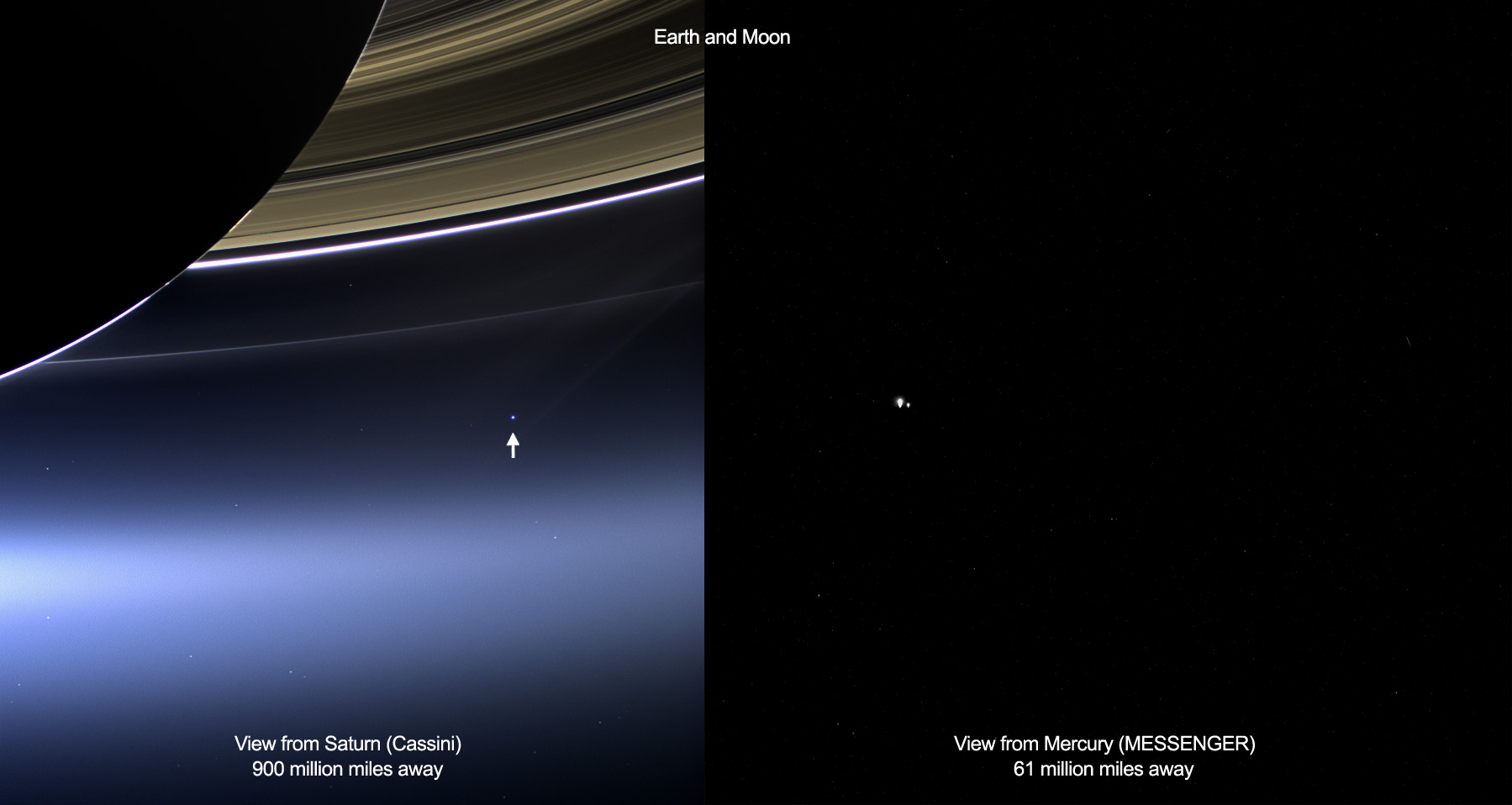
What does the Earth look like from space? Last Friday, the MESSENGER spacecraft, currently orbiting Mercury, photographed the Earth and Moon. On the same day, the CASSINI spacecraft, orbiting Saturn, did the same. If that intrigues you, check out Astronomy Picture of the Day ('APOD' to the cognoscenti). Hey, everyone you know--and I mean EVERYONE--is in those pictures. I'm sure if we were watching one of those high-tech crime dramas like NCIS or CSI we could get the resident geek-cop to "zoom in" and see our smiling faces. Funny, whenever I zoom in on photos I get less detail, not more. And I certainly can't read license plates! But that's OK, I like a good show, and I can live with some occasional lapses into techno-nonsense.

Saturn is about 900 million miles from Earth. Mercury is about 61 million miles away. You get that far away, you can't see much, just some dots in the vastness of space. And that's what we are: cosmic dust motes. In the big scale of things, humans don't amount to much. In fact, the bacteria cells we carry around in and outside of our bodies are more numerous than our human cells. Amazing notion, eh? The miracle of life is still a miracle, of course. But for now the only ones who can appreciate their own miraculousness are all in the same photo. And we don't look like all that much. I find the enormity of the universe comforting, not terrifying. I like the mystery, the awe, the wonder. I'm not afraid of uncertainty. In fact, I embrace it. Uncertainty means you get to keep exploring, seeking, questioning. Nature is pretty goddamn trippy, don't you think?


21 April 2013

The Oil Drum

I came across this website--The Oil Drum--some time ago, and I'm finding myself spending more and more time reading the posts there. It's hard going. They assume you know a hell of a lot about global energy and economics, and they use so many acronyms they have a FAQ for them. But two things keep me coming back. One, the site descriptor is "Discussions About Energy and Our Future." Who isn't interested in that? Two, their mission statement appeals to me:
1. Raise awareness
2. Host a civil discussion
3. Conduct original research in a transparent manner
4. Create a global information community working toward a common goal
Simple. Direct. Meaningful. Who could argue?

I tell my students that everything they know, love, and hold dear depends on cheap, abundant energy. Sure, the Bill of Rights is grand and all that, but without cheap, abundant energy it would all go "poof." Americans like to believe that their wealth and freedom is about the triumph of their ideology. Unfortunately, no ideology, no matter how righteous, trumps Nature. More specifically, the Second Law of Thermodynamics. I like to say the First Law is "You Can't Get Something for Nothing." Seems reasonable to most people. That electricity you use to power your computer came from something like atomic fission, the burning of fossil fuels, or dammed water surging through penstocks. The Second Law, however, says "Shit Happens." More specifically, "Shit Has Always Happened and Will Keep Happening." Order, in any system, requires energy inputs. That energy stops coming in and the system will become disordered. Chaos is natural. The Gershwins understood:

In time the Rockies may crumble, Gibraltar may tumble . . .

Yeah, that's about it. Everything requires energy to keep it going. Your house needs maintenance to keep it from falling down. You have to eat or you will wither away and die. You car needs gas or it won't go. Your society needs labor--both physical and mental--to sustain it. And the benefits you accrue from being a member of said society go along with that. In the days of the Founding Fathers there was human labor in abundance like indentured servants, debtors, and African slaves. There was also lots of easily-exploitable timber, water, and topsoil. It's not a coincidence that rights for women, immigrants, and African-Americans came AFTER the Industrial Revolution. Societies that don't have cheap, freely-available sources of energy are the same societies that have grinding poverty and oppressed citizens.

So, if you care about your future, your wealth, and your freedom, you care about energy and where it comes from. We, that is, the 300 million Americans and the 7 billion world citizens, have already plucked the ripest, juiciest, and lowest-hanging fruit on the energy tree. What's left is harder to reach. Aren't you the least bit curious about how we'll get it?

16 March 2013

Nuke People

I spent this past Friday at my alma mater, UC Berkeley, attending a workshop called Seeing Radiation: Nuclear Science Experiments. It was put on by the American Nuclear Society and hosted by Cal's Nuclear Engineering Department. The program was designed especially for science teachers, hence my professional participation. I previously attended the same workshop on March 11, 2011, which was the day of the tsunami in Japan following the massive offshore earthquake and the subsequent crisis at the Fukushima Daiichi facility. Despite being surrounded by some of the world's most knowledgeable nuclear scientists, we could learn nothing more than what everyone else knew from the news reports. If the workshop had been a week later, we would have been on the cutting edge of the investigation as Berkeley professors and students played a big part in the analysis of the tragedy. Our main instructor both times was Mr. Brooke Buddemeier, a "health physicist" with Lawrence Livermore National Laboratory. He ran the activities and reviewed the basic concepts. We looked at different kinds of ionizing radiation and discussed a variety of health and safety issues. With the help of some graduate students and instructors from the Department we not only put together cloud chambers and used Geiger counters, we got to take both home with us!

Brooke is a relaxed and engaging speaker and he handled our many questions skillfully and gave us a lot to bring home to our students. We also heard again from the brilliant and articulate Dr. Erik Norman, who gave us an overview of basic nuclear theory, and the funny and irreverent Dr. Peter Hoseman, who talked about his research in materials science. In 2011, we got a tour of the old cyclotron building ("up the hill" at Lawrence Berkeley Lab) which is now the Advanced Light Source. This time we toured the research facilities on the main campus and met with doctoral candidates who talked to us about their projects. I was struck by the seriousness, enthusiasm, and openness of the youngsters and the obvious passion for their work and potential careers in the nuclear industry. It gave me a lot of hope for the future of nuclear science. My father-in-law, Bill Rothwell, was one of the first generation of physicists trained in reactor technology at Oak Ridge National Laboratory in the early 1950s. Those men, of course, are all retired or passed on, but I like to think this new crop of kids will be more than adequate replacements. Radioactive materials are used to make electricity, diagnose and treat medical conditions, search for oil and other resources, protect our borders, analyze structures, and investigate the very nature of our universe, among other things. It was both fun and rewarding to spend the day with all these bright and curious people--I need to do that sort of thing more often!


24 January 2013

Earthbound

"He has no place to go, no home but the earth."

Thus concludes Charles F. Park, Jr. in his 1975 book Earthbound: Minerals, Energy, and Man's Future. I'm a big fan of space exploration, manned spaceflight, and science fiction stories, but it is unlikely anyone I will ever know will live on another planet. Visit, sure. But live? Be part of an alien ecosystem? No. That's not going to happen soon. We are stuck here on the earth and have to make the best of it. The Andromedans or Cassiopeians or Alpha Centaurians are not going to suddenly appear and give us free, limitless, non-polluting energy. We'll still have to farm our food and we'll still need all the other stuff we currently grow. And, like always, we'll  have to mine the rest. I'm interested in things and how they get put together. Where does the lead for my car battery actually come from? How is it transported and processed? What does it take to turn rocks into something like a toaster or a hammer? Earthbound may have been dated, but it piqued my abiding interest in economic geology. I suppose growing up surrounded by things like seaports and oil refineries got me thinking along those lines. I wonder about the connections necessary to put an iPad in someone's hand, the actions and events along the way, the myriad of both social and physical structures required. No matter what, when you follow the chain to the end, there's always some guy digging a hole in the ground and pulling out some useful chunk of the earth. I want to know more about that guy, that hole, and the treasures buried there.

22 January 2013

Conjunction!

Not much of a photo, I'm afraid, but the conjunction last night between Jupiter and the gibbous moon was pretty neat:


According to my Abrams Planetarium Sky Calendar the two celestial objects were 1.3º apart.

01 January 2013

Closest Approach

This week the Earth comes closest to the Sun on its annual journey along the elliptical path. The distance between the two bodies drops to a mere 91.4 million miles or about 147 million kilometers. Around Independence Day the Earth will be at its furthest point: 94.5 million miles or about 152 million kilometers. Stick two pins in a piece of cardboard and tie a loop of string between them. Using a pencil, trace out a shape by stretching the string all the way out. What you get is an ellipse:


The two pins represent points called the foci (plural of focus). If the two foci were one point, your ellipse would be a circle. Imagine the Sun is one focus. The Earth's orbit is the ellipse. When the Earth is furthest from the Sun, it is called aphelion. When it is closest, it is called perihelion. "Helios" is Greek for "sun" and "ap-" and "peri-" mean "far" and "close." You can see that the ellipse illustrated is highly exaggerated. The Earth-Sun distance only varies by about three million miles, so if we could view the orbit from space it would look very much like a circle. Most people have a hard time with the notion that we residents of the Northern Hemisphere are closer to the Sun in winter and further in summer. It is below freezing where I live today, for example, and will likely be in the high 80s or low 90s (Fahrenheit) on the Fourth of July. We should conclude, then, that the distance from the Earth to the Sun is not important when talking about the seasons. Three million miles may seem like a lot, but not when you are 90+ million miles away! Every schoolkid ought to know that is is the axial tilt of the Earth that gives us seasons. If you have ever spent time in the Tropics, you know that the day length varies little throughout the year. Whereas we folks who live in the Temperate Zones experience long summer days (and short nights) and short winter days (and long nights). The Earth's axis tilts 23.5º from the plane of its orbit, which is why the Tropic of Cancer is 23.5º north of the Equator and the Tropic of Capricorn 23.5º south. This axial tilt means that solar radiation is spread out over a larger area during the Northern winter and thus we get colder weather:


Try this with a globe and flashlight. You'll see the beam will cover more ground when the Northern Hemisphere is tilted away (winter) and be more concentrated when tilted toward the light source (summer). This is a simple concept, and it gives us an easy scheme for describing seasonal change. After you get a handle on it, ask your friends what they know. You might be surprised how many of them have no grasp of grade school science. Be a good citizen and enlighten them.

HAPPY PERIHELION!!


24 December 2012

Crazy People

Yesterday I drove through a blinding snowstorm. Literally, it was blinding. The windshield wipers on my 1988 pickup were feeble and could not keep pace with the snowfall. My buddy in the passenger seat had to roll down the window and reach out a grab the right-hand blade and bang it against the windshield to free the ice chunks that built up. I would do the same on the left side while trying to keep the vehicle on the road and not veer into the considerable drifts and snowplow berms. The defroster had to labor to keep the window clear on the inside, made worse by the two of us opening the windows and allowing fresh gusts of snow inside. Each of us had a cloth and we would vigorously wipe our side to keep ahead of the endless condensate. Visibility at one point dropped to nothing--we had to stop, get out, and scrape the windshield before resuming! Good thing my Toyota 4WD hugs the road like a tank. I did not have to worry about slipping and sliding. I've spent a fair amount of time driving on snowy and icy roads and my technique is pretty good. My buddy is a four-wheeling expert and he has given me many useful pointers and tips over the years. Suffice to say we made it safe and sound to the parking lot at Mt. Ashland Ski Area after that harrowing ten-mile ordeal. I was so keyed-up I ran straight to the bathroom through the howling wind to empty my tortured bladder. I was so in need of relief that I was oblivious to the swirling snow that stung my hands and face like bits of sand. Back in the truck, we suited up for our day on the mountain. The southwest wind would smack us around with gale-like force, but we managed to get our skis on and point them in the general direction of the chair-lift. The overcast sky hung low and made it difficult to see much past about twenty or thirty feet. The wind scooped up the fresh-falling snow and spun it around and tossed it back down again, obscuring landmarks just as you made them out. We took the plunge nonetheless and made our way mostly by feel to the roped off lift-lines, joining about thirty others eagerly waiting for the chairs to start loading. All I could think of at that point was that everyone standing there was a crazy person. Crazy to drive up the mountain. Crazy to strap on skis and boards. Crazy to get on a chairlift and careen down a slope. Crazy to "chase freshies." Because that is why everyone was there--the piles and piles of new snow. Powder, or pow-pow in ski argot, is something of a holy grail to the alpine thrill-seeker. Done right, a run through virgin snow ("first tracks") is akin to floating, much like riding a wave to the surfer or free-falling to the skydiver. Done by intermediate hacks like myself, it can be a futile, frustrating endeavor. You really have to be a crazy person to pursue this activity. I even said so in the line: "everyone here is crazy!" No one argued. They just nodded and went on. Fortunately my skiing skills have improved over the last few years and I really can get down in the deep stuff and make some nice turns and even occasionally look halfway like an advanced skier. My buddy, an outstanding skier, always reminds me that I can keep up with him so that must mean I'm pretty good. Bit of a left-handed compliment, that, but I'll take it. In the end, despite some on-going equipment issues, I had a good time. In the lee of the trees the runs were protected and the cloudbank lifted enough so we could see, and we put together some good stretches. I surprised myself with some very nice sequences and kept up with another fellow we know who is always up there and is a very accomplished powder-hound. My screaming quads told me to quit long before the weather wore me down. With thicker thighs I could have managed another few hours and been utterly indifferent to the appalling conditions. I wonder if that means I'm now one of those crazy people.

31 July 2012

Dare Mighty Things

This Sunday, the 5th of August, at 2231 Pacific Daylight Time, the Curiosity rover is scheduled to land on the surface of Mars. The red planet, on average, is about 158 million miles away. That creates an interesting communication problem we don't experience here on terra firma. A radio signal--traveling at 186,000 miles per second--can circumnavigate the earth a little more than seven times in one second. The earth's circumference is about 25,000 miles, and geostationary satellites orbit at just short of that distance, or about 22,000 miles. Thus we earth-bound mortals do not notice any significant delay when we use phones or TVs. Rather, what I should say, is that any delay we do experience is not due to the speed of light. Even those large distances are nothing to an electromagnetic wave. But Mars is another story. Divide 158 million by 186,000 and you get 850 seconds, or about fourteen minutes. That's how long it will take a message from Curiosity to reach the army of scientists, engineers, technicians, and the rest of the people at NASA and the Jet Propulsion Laboratory. When the spacecraft descends from orbit into the Martian atmosphere, it will take about seven minutes for all the stages to be completed and the rover to be set upon the surface. That means it will be seven additional minutes before they will know if everything was OK at the start of the descent. Add another fourteen minutes before anyone will know if the landing worked and Curiosity is intact and able to complete its mission. And if they need to send a signal to make a correction or initiate a program, they won't know if it has been received for another 28 minutes.

What agony! After months of planning, preparation, construction, and testing, not to mention the almost two years of space flight required to get to our planetary neighbor, the radio delay has to be an exquisite kind of torture. The Mars Science Laboratory is an ambitious effort, being ten times larger than the other Mars rovers and requiring a more complex deployment procedure. Unmanned, robotic space exploration is far better for science than putting people up there. When you use humans you have to spend so much time and energy keeping them alive that very little actual work gets done. These missions, nonetheless, are daring, sophisticated enterprises that ought to inspire awe and excitement amongst the citizenry. Here's something Americans are doing together, with public entities and private enterprise collaborating and cooperating. It isn't about party politics, and all the various ways we can divide ourselves into tribes and holler at each other about words and symbols are mercifully absent. Instead, our fellow humans are reaching for the stars, daring to do mighty things that will benefit all of us regardless of nation or creed.

I think it's fantastic, and I hope they succeed brilliantly. Some day Americans will return to space to explore beyond earth orbit, adding the drama of actual astronauts out there risking their necks in pursuit of our collective dreams. Right now, though, the pathfinders are charting the course for us, showing us the hazards, and revealing the engineering solutions we need to make the possibilities real. The men and women at JPL may not leave their seats, or go too far from their computer screens, but they are sowing the seeds for a 21st century Magellan to reap. Here's to a homegrown Cook emerging in the next decade or two! I can't wait much longer than that, I want to be young enough to jump for joy when he or she makes it, unlike those great captains, all the way safely home.

22 July 2012

O'Connor's Three Laws of Science

I often tell my students about O'Connor's Three Laws of Science. I was inspired by Newton, of course, as his Three Laws of Motion are the jump-off point for many explorations of mechanical phenomena. My laws are more abstract, and are about the nature of science itself, not about a specific area of study. Number One: all measurements are uncertain. I like to say the corollary to Number One is find the degree of uncertainty you are willing to live with. If you are rough-framing a house with 2x4s, being off now and then by a quarter of an inch is no big deal. If you are building cabinets, however, being off a quarter of an inch is a catastrophe. Measure as precisely as you need to. And please don't tell me the answer with the eight decimal places your calculator gave you! People on a diet care about pounds, not ounces. Number Two: science is a description of nature, not an explanation. As Alfred Korzybski opined, "the map is not the territory." Science does not concern itself with Truth, and at least, in my view, it should not. Leave that to philosophers and holy men. They can talk all they want about the subjective and the mystical, none of those things can withstand the rigors of experimentation. Science requires repeatability--if you can't get my results then one of us is wrong. I don't mean to say that subjective experiences aren't real, they just aren't amenable to analysis. Scientific "truths" are contextual, that is, they are only as good as the paradigm they fit within. (I use that word in the sense that Thomas Kuhn did in his The Structure of Scientific Revolutions.) All experiments operate within a theory of how nature works. Scientists don't investigate randomly--they look for things they believe they "should" find, that is, what the theory (or dominant paradigm) predicts. Or they look at anomalies, things that don't fit the theory, and try to enlarge their understanding so that these outliers will fit within the current models. Only when the paradigm fails to produce satisfying (i.e., consistent) results does a "revolution" occur. Think Copernicus, or Einstein. Nature doesn't change, only our way of seeing it. Number Three: correlation does not imply causality. The Romans would have said "post hoc, ergo propter hoc." That's a logical fallacy, and the Greeks (Rome's teachers) would have drilled that notion into their rhetoric students. Just because A happens after B does not mean that A causes B to happen. The sun rises after my alarm goes off. If I turn off my clock, will that plunge the world into darkness? We see this sort of thinking every day, especially in politics. So-and-so got elected and then the economy (or whatever) did this-or-that, obviously so-and-so deserves the credit or blame. I remember when everyone got excited that sunspot cycles appeared to correlate with drought in California. That's it! Explanation! Mystery solved! Until the drought persisted, of course, and we were left once again with the complexity of the global climate system.

So that's it. Science in a nutshell. And I like to end my talk with my favorite line from Shakespeare:

               There are more things in heaven and earth, Horatio,
               Than are dreamt of in your philosophy.
               (Hamlet, Act I, scene V).

To me, this means never underestimate nature. The vastness of the universe should awe us and keep us humble. Science is a product of the human mind, and is thus subject to all the vagaries and frailties of humankind. It is also the most powerful and most fruitful of all human endeavors. Without science, I would like to note, religions would have nothing to talk about. The pope, for example, spends a lot of time on birth control. The pill wasn't invented by priests, man. I'm not religious, as you might imagine, but I also don't really see the supposed conflict between science and religion. After all, religion is about things that cannot be measured or experimented upon. Religions don't have "testable" questions. If people want to believe that tablets with God's Laws on them were handed out to Moses or discovered by Joseph Smith, that's all fine and dandy. Science can't respond to such notions because they cannot be falsified. Many scientists possess religious faith (like Newton, for example), and that seems to make the point moot, don't you think? A belief in the afterlife won't prevent anyone from determining the chemical composition of nebula, and reading the gospels won't stop a polymerase chain reaction.

Sorry for the long-winded rant, I got inspired this morning when I dropped in the on the website BETTER EXPLAINED and read their delightful thumbnail sketch of Bayes' Theorem. Good stuff, check it out!

19 May 2012

Ring of Fire

We should get a good look at tomorrow's annular eclipse. Annulus (or anulus) is Latin for ring. With the moon at apogee, the apparent size of the disk will not entirely block the sun, thus giving viewers in the path of annularity a chance to see the "ring of fire." Here in Yreka I expect to enjoy it in my back yard. The State if Jefferson, in fact, is the place to be to experience the event. Sky & Telescope lists the duration times for both Medford, Oregon, fifty miles north (2m 46s), and Redding, California, 100 miles south (4m 35s), so I think we are in the right spot. The National Weather Service gives me "mostly sunny" as the daytime forecast and "partly cloudy" for the evening. The maximum eclipse predicted for Medford is at 6:25:56 PDT and for Redding at 6:28:38, so the sun will still be well up in the western sky. I've prepared a big pinhole box projector (from the Dell box my computer came in) which gives me a solar image of about one centimeter in diameter. I also have some mylar eclipse glasses for direct viewing. Toss some steak and veggies on the BBQ, drink some beer, kick back on the patio, and look west is the plan for Sunday afternoon. I hope you get to enjoy this unique opportunity as well!

16 April 2012

Creeping Charlie

A plant with weird little purple flowers is thriving in my lawn. I can tell it is a mint--the square stems and opposite leaves are diagnostic when identifying forbs in the field. As are the bi-labiate (two-lipped) flowers. I was taught the botanical family name for Mint was Labiate, but I see now it is called Laminaceae. Taxonomists are fussy sorts and are always renaming things. The stalks and leaves are reminiscent of cilantro, if cilantro had a hardy, mountain man version of the stuff you buy in the produce section. It is Glechoma hederacea, also known as ground-ivy, cat's foot, or creeping Charlie. The venerable Philip A. Munz called it Gill-over-the-Ground and said it had "retrorsely puberulent" stems which means "backward or downward with very short hairs." How I love botany talk! I note that Munz' magnum opus A California Flora is out of print, so I'm hanging on to my copy. It, like me, came to life in 1959. According to the Wikipedia entry, Saxons brewed with Glechoma hederacea before hops became commonplace, thus one of it's common names is ale-hoof. My encyclopedia of poisonous plants lists it as toxic to horses, but it is supposedly edible by humans either as a salad green or brewed in a tea. Those of you who'd like to help me get rid of it are welcome to all you can pluck out. Bon appetit!

16 January 2012

Speed's Trail

West of me, about a mile and a quarter as the crow flies, is a high knobby peak. It didn't have a name until today. The USGS topo for Yreka says it is 1154 meters (3786 feet) high, which is 344 meters (1129 feet) above my house. We hiked up there in honor of Martin L. King, Jr., and discovered a sign that read "Speed's Trail" and below that "Speed Jones, 1923-2007." I guess we'll call it "Speed's Peak" from now on. The combination of roads and trails that zigzag to the top could keep you busy for months, but we managed. Speed's Peak is the highest of a northwest-to-southeast trending group of four knobs that drop successively to 947 meters (3107 feet) in about three-quarters of a mile. It's a funny little fingerling ridge that seems only remotely connected to the commanding Humbug-Mahogany Point-Gunsight Peak prominence that marks the eastern terminus of the Klamath Mountains. This little cluster of steep, rocky hills is a popular playground. Kids paintball in the lower parts, dirt bikes crisscross the midsections, hardy mountain bikers leave tracks at the junctions on the wide saddles, and a few hikers push on to the top. There are abandoned party spots and homeless hideouts amidst the scraggly cedars and skinny pines. It's not in the guidebooks, but it is a hell of a view and a good workout. I got lost trying to make sense of the geology. I could see cobbles of quartzite, and broken masses of phyllite, chert, and possibly schists. The rocks were green with what I think was chlorite, and there was lots of serpentinization. Large clusters of dark stuff bewildered me. The map was no help, lumping it all into "Mezosoic meta-sediments" and other non-committal verbiage. I suppose it's not the rocks that matter, but the story of how they got there. We got there by putting our boots on and huffing and puffing and sweating on this cold but calm and sunny day.

31 October 2011

The Veil

The ancient Celts believed that the Samhain marked the time between summer and winter. This "cross-quarter" day (half-way from the Autumnal Equinox to the Winter Solstice) actually makes more sense as a seasonal dividing line for those of us living in the temperate zones. After all, it has been below freezing at my house--just south of the 42nd parallel--for the last week. The Celts also believed that this time of year was when the veil between the material and the spirit worlds was the thinnest. Thus you made masks and carved scary faces in vegetables (probably turnips, pumpkins are from the New World) to keep the ghosts of the dead away. I love the fall, and the approach of winter is always exciting because I like to ski. This last week I've been reading a book called The Meaning of Quantum Theory by a UK writer named Jim Baggott. This remarkable theory is at the heart of contemporary physics and is wildly successful at predicting the outcomes of experiments. The problem is that no one is quite sure what it means. The results of quantum theory are spooky and give a picture of "reality" far at odds with that of the classical mechanics of Newton. Quantum mechanics probes the veil between physics and metaphysics. What the theory tells us is unequivocal: particles behave like waves some of the time and like particles some of the time, measuring the position of a particle makes it impossible to also measure its momentum, and the properties of two separated particles appear to be dependent on each other. Quantum mechanics may possibly violate the postulates of special relativity (another wildly successful theory) and might entirely upend our notions of causality and the flow of time. Or not. No one is quite sure even though the leading minds of the world have been working on it since the 1920s. I'll finish the book tonight if I don't get interrupted too often by trick-or-treaters. It's good stuff. I'll admit that I have to skip most of the math parts as calculus was over thirty years ago. There's like this veil between the squiggles on the pages and my brain!

25 October 2011

Skepticism

According to Eric Partridge, my word guru, "skeptic" is from Greek and means "doubt." Skepticism is a good thing. In science, it is crucial. Many confuse the meaning of the word with that of "cynic." Having been accused--many times--of being a cynic, I'm used to the mix-up. The ancients who called themselves Cynics ("the snarlers") were contemptuous of society's conventions but nonetheless strove for virtuous conduct. The modern meaning of cynic is one who doubts all motives but selfishness. That is, a person who does not believe altruism exists. This has nothing to do with asking good questions and demanding to see the evidence before making a conclusion. People don't like skeptics because skeptics don't like sloppy thinking. Skeptics like to account for all the possibilities before embracing a course of action. This often comes across as contrariness or obstructionism, but it is really just trying to see things as clearly as possible.

Those in the American political scene who doubt the science behind climate change are called skeptics, but this does a disservice to real skeptics. Real skeptics are not merely deniers. Real skeptics look for flaws in an argument and demand to be convinced with logic and facts. Deniers don't require that sort of rigor. They already have their minds made up and you won't get anywhere with them using silly things like evidence. One skeptical scientist--Richard Muller of UC Berkeley and Lawrence Livermore Lab--recently published a piece in the Wall Street Journal explaining what his current research has revealed about global warming. His was a sort of meta-research as his team looked at already-existing data and analyzed its reliability. They concluded that the numbers were good--global temperatures are on the rise. They made no statement about whether the cause is anthropogenic, but that wasn't the point of the study. Here's Dr. Muller:
When we began our study, we felt that skeptics had raised legitimate issues, and we didn't know what we'd find. Our results turned out to be close to those published by prior groups. We think that means that those groups had truly been very careful in their work, despite their inability to convince some skeptics of that. They managed to avoid bias in their data selection, homogenization and other corrections.
That's science in a nutshell. If the data is good, it will hold up to scrutiny. If the methods are good, the data is trustworthy. Transparency and openness lead to progress. This is exactly the opposite of politics, where lies and half-truths are the meat-and-potatoes of campaigning. Where secrecy, denial, and re-writing history are the essential skills candidates master. Where visceral responses are more important than analysis and where being brainy is a handicap. Screw politics and learn to think like a scientist!

Read some more about Muller and the BEST project here.

13 October 2011

subrecursive hierarchies of functions*

The world lost another tech giant. Dennis Ritchie was the inventor of the C programming language and a co-creator of the UNIX operating system. He died this week at the age of 70. Originally from New York, he earned degrees from Harvard in both physics and applied mathematics, and spent his career with the famous Bell Labs in New Jersey. Those software creations--C and UNIX--are the foundations of most of today's systems. Macintosh computers, for example, run a Unix-based OS. Programmers learn things like C++ and Java these days, which are the progeny of C. Most of the servers that hold this whole intertubes thingie together run UNIX or a variant. Mr. Ritchie didn't do stuff that tech consumers notice. Instead he did the real brick-and-mortar work of the Information Age. Those of us lucky to be living in the wired world are standing on foundations laid down by this guy and his contemporaries. Recquiescat in pacem.


*the subject of Ritchie's thesis
I don't know what it means, either.
 

03 September 2011

Rock cycles

I took a walk one afternoon this summer up the Gully Trail at Greenhorn Park. Eventually it peters out and joins the Humbug-Big Ditch trail junction, and if you keep climbing you get to a road that leads to the top of the ridge. Mountain bike riders call that stretch "The Wall" because it is steep and very hard going. I have yet to make it to the top on my bike, but my feet got me there well enough. One of the road cuts on a wide switchback glistens with a grayish-green rock outcrop that screams "serpentine" to the native Californian. Sure enough, there's serpentinization, but that's just on the surface. I cracked a few of the scattered cobbles open and was presented with an opaque black rock that fractured easily. Back home, it showed little or no cleavage, a minute and hard to discern crystal structure, left a black streak, and attracted a compass needle. It was magnetite, an ore of iron.

I was looking, actually, for chromite, an ore of chromium that contains much iron--the whole county is riddled with the stuff. The Klamaths sit on a basement of peridotite, a rock formed in the mantle. Ancient bits of old seafloor have been thrust landward by the inexorable grinding of the tectonic plates. These rocks are known as ultramafic to the geologist--silicates rich in magnesium and iron. Mineralization occurs along fault lines and contact points with younger igneous material. Magnetite is interesting in that it shows both of iron's oxidation states, what were once called the ferrous and ferric forms. Nowadays the more prosaic iron(II) and iron(III) are used. FeO, iron(II) or ferrous oxide, found alone is called Wustite by the mineralogist. Fe2O3, iron(III) or ferric oxide, is the better-known hematite. The magnetite form is known as iron (II, III) oxide and can be written Fe3O4. All three minerals can occur as commercial-grade iron ores. Magnetite is used as a catalyst in the Haber Process that converts ("fixes") atmospheric nitrogen and produces ammonia. Ammonia is one of the cornerstone chemicals of the industrial world as it can be easily oxidized to make fertilizers and explosives, and is also the basis of some plastics, fibers, dyes, and pharmaceuticals. About 130,000,000 metric tons are produced annually worldwide.

I wasn't thinking of any of that when I huffed by on my Stumpjumper last week. I was just trying to keep up a steady pedaling and not get out of breath. It was hot, my face was flushed, sweat was pouring down my cheeks, and my heart was beating with a fury inside my chest. Between my feet and my wheels, I hope to stumble across many more cool rocks and minerals here in the State of Jefferson.

21 July 2011

Thirty years ago . . .

. . . I was finishing my senior year at the University of California. The space shuttle Columbia made its maiden voyage on April 12th and I was awarded my B.S. degree on June 13th. Columbia broke up over Texas during re-entry on January 16, 2003. That was its 28th flight. Sister ship Challenger, launched on April 4th, 1983, was lost at the start of only its 10th mission on January 28, 1986. Atlantis, first launched on October 3rd, 1985, touched down at Cape Canaveral early this morning, closing the door on the entire shuttle program. It was the 33rd trip for Atlantis. The newest member of the fleet, Endeavour, was first launched on May 7th, 1992, and completed its 25th and final voyage on June 1st, 2011. Workhorse Discovery made 39 flights between August 30th, 1984, and March 9th, 2011. I remember talk at the time of Columbia's debut was that each shuttle would be capable of 100 missions. Although NASA fell short of that optimistic prediction, thirty years of performance from such a complex machine subject to such demanding conditions is still an impressive accomplishment. If you want to do pure science, satellites, robots, and unmanned probes are much better than human-filled spaceships. If you want to explore, you need people. I hope NASA can continue to do both.

10 March 2011

Discovery

It was a clear October morning in the Mojave Desert twenty-three years ago when I got to see Discovery touch down at Edwards Air Force Base. This was the first Space Shuttle flight in over two years after the Challenger disaster in January of 1986. The landing area was packed with spectators and well-wishers, and the general feeling was one of great relief when the big bird came down without a hitch. I was there when Challenger came down on her final landing in November of 1985. There was hardly anyone in the big lake bed parking area at the time. No one had any inkling it would be Challenger's last successful mission. Space travel is inherently dangerous, but the regularity of the program's success lulled us into believing it could be routine. It took another disaster, the terrible break-up of Columbia over Texas on its return flight to Canaveral in 2003 to remind us once again that this sort of thing is risky--very risky. You can have all the best scientists, engineers, and technicians and still lose a payload, a rocket, or a crew. I like to say that the first rule of the universe is that "Nature f----s with you." And that the second rule is "People can't do much about Rule No. 1."


Discovery will fly no more. She came down on Wednesday having flown 39 times since 1984 and having logged 148 million miles. Endeavour is set for an April launch, and Atlantis for June. That's it for the Space Shuttle after three decades. That will be a sad day for me, as I've been a fan of humans in space since I was a boy following the Apollo missions. The real exploration of the final frontier is done better by satellites and robots--one only has to look at the pictures from Cassini and Opportunity to know that. But humans are explorers, and will continue to explore space from their rockets and spaceships. The ISS is still up there, still working, and still filled with explorers. Let's not forget about them.

06 February 2011

Weekend crescent

I caught a glimpse of the very young crescent on Friday night just before 8:00 p.m. local time (PST). It was just getting ready to set over the western foothills. On Saturday I saw the moon late in the afternoon, high in the sky, and watched it brighten in the deepening twilight. Tonight Jupiter was the crescent's companion, and I could really appreciate the earthshine glowing on the full face of the disk. The bright bottom limb looks a bit like a canoe or gondola, with its pointy horns nearly even with the horizon line. The moon is smiling at us! The unseasonably warm, dry, clear weather may be a bummer for the skier in me, but the flip side is an outstanding view of Luna in all her early-phase glory. First Quarter is not until Thursday--get outside and enjoy the beautiful young moon!

03 January 2011

Uranus

I discovered an excellent new astronomy blog called Prime Time. I was looking for help with Uranus. Uranus is the favorite planet of schoolkids everywhere. They always ask if you have pictures of Uranus. Nowadays you are supposed to say Uranus like "urine us" which isn't any better. The alternative is "your AH-nus" which just sounds like you are being snooty. Tonight, with the help of the description and map on the aforementioned Prime Time blog I was able to see Uranus. This week it is in the same binocular field with Jupiter, and with a little patience I was able to pick out the far distant planet once known as "The Georgian Star." I'm lucky to live in a place with dark skies. Even though I live in town and there are all the usual sources of light pollution (like streetlamps and porch lights) visibility is still very good. The hardest part is keeping the binoculars steady! Once I could do that I could see Uranus easily. The bluish-green tint the planet is known for would jump out at me when I averted my eyes from the spot. Uranus is more than a billion miles from Earth, closer to two billion, in fact. That's a long way for the sunlight to get there and back again so we could see it this week.